
The Identified Patient
In politics, as in therapy, the problem is usually deeper than it seems.


In a dysfunctional family (or country), there’s often one person who creates all the drama. Family therapists call this the “identified patient.” Sometimes it’s a raging teenager, or a father who drinks too much.
This person gets a lot of attention, understandably. But their antics tend to distract everyone (including the therapist) from other, deeper problems in the family.
In my family, my mother was the identified patient. She was the one who dictated the mood of the household, up or down. She acted, and we reacted. Which meant that the rest of us rarely had to consider our own contributions to the family dynamics.
Strangely, her role was not obvious to me until she died. One night, I was loading the dishwasher, and a family member turned to me and said, “Doesn’t it just feel like we were all revolving around the sun, and suddenly it’s gone out?” That is how it felt. Things were calmer, but we were adrift, with nothing left to orbit. And when the light eventually came back on, it exposed our own problems, which had been hiding in her shadow for decades.
In America, and many countries around the world, the identified patient is President Donald Trump. His cruel impulses, self-dealing policies and reckless deputies are sending shock waves through Minneapolis, Venezuela, Greenland and ________ [I’ll leave this blank because, by the time you read this, there will be another location].
It breaks my heart to watch this pain rippling across the country and beyond. This is a hard time, and I am not suggesting it can be anything else. But I do want to consider—just consider—what happens when we let the identified patient become the sun.
In the past six months, the New York Times has named the identified patient in a headline some 4,520 times. That’s roughly 25 Trump headlines a day. (During the equivalent period under the previous administration, the newspaper mentioned President Joe Biden in a headline just nine times a day.)
Nearly once a day, those headlines include the words, “Trump says” — as in, “Trump Says He ‘Probably Should’ Take Obesity Drugs, but Has Not” or “Trump Says He Bruised His Hand on a Table.”
This fixation is partly necessary. We’re talking about an erratic, egomaniacal leader who routinely humiliates, threatens and endangers his fellow Americans and people around the world. He controls the most powerful military force on the planet. He requires attention. But what kind, and how much?
Imagine if your aging father had, for the past decade, created regular chaos in your family. What would it mean if you texted your adult siblings about him 25 times a day? “Papa Says He ‘Probably Should Take Obesity Drugs, but Has Not! 😖”
It would mean that you were not doing much else, right? You were possibly neglecting your own children, not to mention your mental health. And you were certainly not preparing for the inevitable day when papa was gone.
So it goes with countries. The identified patient becomes the obsession of his enemies and his supporters, while the foundational cracks that he used to maneuver his way into power only deepen. Then, when papa leaves, an eerily familiar stepdad character soon appears.
This is a familiar story in certain African countries, where “big men” characters — larger-than-life dictators — rule politics and absorb all the media oxygen. Cris Chinaka, who covered conflicts across southern Africa for Reuters, has warned journalists against this “hyper-personalization” of a conflict:
“Africa is dominated by big men, and the news media often oversimplify the conflict. It’s happened time and time again when some of the big men have left and the conflict is still on the table … we put emphasis in the wrong areas sometimes.”
This fixation on the identified patient means we have precious little time, energy or desire left to do the most important work. To repair our relationships, build stronger, better institutions, fight corruption and plan for a very different future so that our children do not inherit the same tragedy.
To break out of this trap, you start by acknowledging you are in it. Then you forcibly widen your view of the problem and the solution — and take action in your own corner of the world.
Instead, in thrall to our identified patient, we start to mimic his behavior. We do the same thing we accuse him of doing.
Under pressure from the identified patient, Texas Gov. Greg Abbott signed legislation gerrymandering districts to create five GOP-friendly seats. In response, California Gov. Gavin Newsom moved to gerrymander his own state, a plan approved by voters in November. This is one logical way to defend yourself from an identified patient. But it does not get us out of the vicious cycle we are in.
In their book Original Sin, Jake Tapper and Alex Thompson did not use the phrase “identified patient,” but the dynamic runs through every chapter. Many Democrats in and out of the White House, they wrote, were “so focused on convincing voters that Donald Trump was a true existential threat to the nation that they put blinders on, participating in a charade that delivered the election directly into Trump’s hands.”
Reporters and Democratic politicians who dared question Biden’s physical or mental fitness for a second term were rebuked and ostracized. These were legitimate concerns shared by a majority of American voters, but the fixation on the identified patient led many Democrats to make tragic errors. As one longtime Biden aide explained to Tapper and Thompson: “[Biden] just had to win, and then he could disappear for four years—he’d only have to show proof of life every once in a while.” To save democracy, in other words, he had to undermine it.
Meanwhile, many Republican leaders and conservative media outlets had already made the exact same mistake, fixating on Biden or The Left as the identified patient. They were so hell-bent on convincing voters of these existential threats to the nation that they, too, put blinders on—and delivered the election to a candidate who behaves in ways they would never tolerate from their own kindergarten-aged children. This is what high conflict looks like. It’s a trap, and everyone suffers, to different degrees.
To break out of this trap, you start by acknowledging you are in it. Then you forcibly widen your view of the problem and the solution — and take countercultural action in your own corner of the world. I have seen this happen again and again in all kinds of high conflict, from political feuds to street violence, and it is the only way out.
This is what Republicans in Indiana’s state Senate did on Dec. 11. Legislators were facing intense pressure from the identified patient in the White House to pass a gerrymandering measure. Indiana state police reported numerous bomb threats and swatting hoaxes against state senators. And still, these lawmakers rejected the measure. They did what they could do, in their community, to opt out of the high conflict tit-for-tat cycle they found themselves in.
Often, the countercultural move is less dramatic. It’s an under-the-radar decision to defy the rules of the conflict. In a small town in upstate New York, a group of locals recently crossed party lines to try to elect a different kind of candidate, as my Good Conflict co-founder Hélène Biandudi Hofer reports in this new story (the first in a Good Conflict series we are calling News 4 Humans).
If you want to take action to break out of the cycle we’re in, notice what the identified patient is doing — and consider doing the opposite (ideally, alongside people you don’t always agree with). This is what 230 Republican and Democratic mayors across America recently did in response to Charlie Kirk’s murder. They signed something called the “Oklahoma City Declaration,” publicly committing to treat each other and their opponents with basic decency, to use restraint on social media and to refrain from apocalyptic rhetoric.
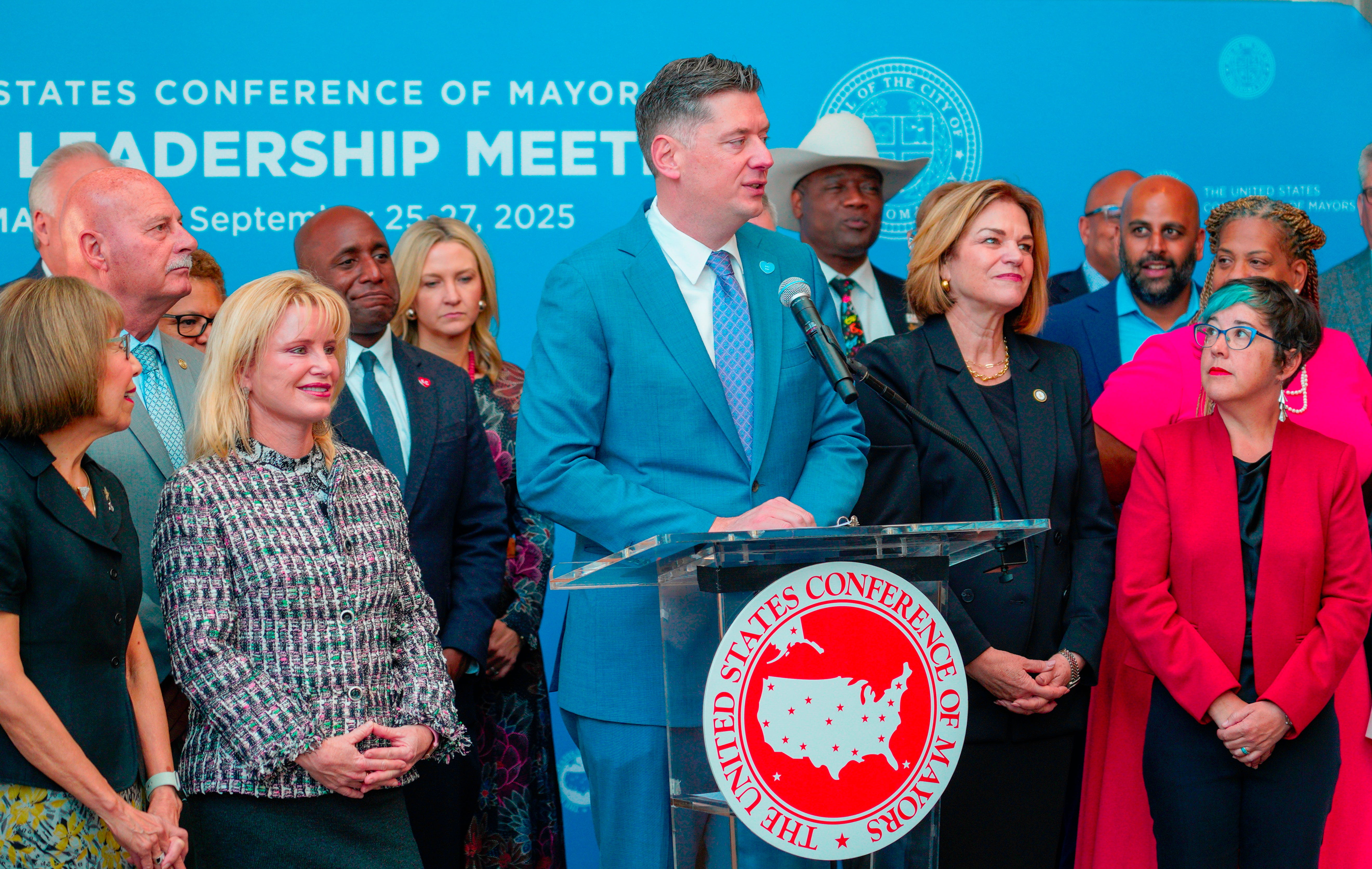
In October, Oklahoma City Mayor David Holt, who had drafted the declaration, signed it with other mayors at the Oklahoma City National Memorial & Museum, the site of the deadliest act of domestic political violence in living memory in America — a place where 168 people were murdered by a fellow American. You can read the full text of the Declaration (and see if your mayor has signed it yet) right here.
Instead of simply repeating whatever outrageous thing the identified patient says, journalists should investigate more interesting questions: Who is resisting high conflict? Where are the rebels? Who is working to reckon with the societal failures that created Americans’ exploitable grievances, from our disgraceful healthcare system to our corrupt campaign finance laws and our absurd, two-party, winner-take-all political system? If these are questions you want to see answered, send a message to journalists in your media feed and say so. They hear from extremists and conflict entrepreneurs all the time; when was the last time they heard from you?
In your own community, look for the Americans who have gone rogue and are quietly working to reinvent politics, journalism, social media, AI and civic life. There is a lot happening in the shadow of the identified patient. (And if you have an example you think we should cover from your community, please tell us about it here.)
This is what good therapists do when they encounter an identified patient in their office. They bring everyone else in the family into the therapy room, too. And they constantly remind themselves that they are treating a sick family, not just a single sick person.
We are a sick family in America right now, let’s face it. And long after our identified patients are gone, we will still be here. It’s time to turn toward each other and build a home we’ll want to live in.

Here’s to orbiting around the actual sun,
Amanda
3 Good Things
“Anyone in Paris Can Decide How the City Spends Its Money.” This Reasons to the Cheerful story by Peter Yeung made me wonder if “participatory budgeting” could help rebuild trust in the federal government, not just local. Basically, it’s a democratic process where community members decide how to spend part of a public budget. A 2025 study found that, on average, places that adopted participatory budgeting saw public trust rise from 55% in 2020 to 70% in 2024.
Deconstructing Marjorie Taylor Greene. This New York Times deep dive on Greene’s break with Trump and public apology for her role in polarizing our politics is worth reading. Reporter Robert Draper asked her deeper questions — and got more substantive answers — than any other story I’ve seen. At one point, she described why she behaved the way she did when she got to Congress: “‘I was attacked relentlessly and was enduring real pain in my personal life’ — referring to her father’s brain cancer, which proved fatal, followed by the dissolution of her marriage. ‘And my emotions were just really raw.’” This is not an excuse, but it is a way to understand why conflict entrepreneurs do what they do. Usually, they are in pain, and they spread that pain around.
6 Trends that Make Electoral & Party System Reform More Likely. This newsletter from political scientist Lee Drutman, author of Breaking the Two-Party Doom Loop, lays out some unexpectedly hopeful reasons why big reforms may not be as far away as they seem.
© 2026 Amanda Ripley. See privacy, terms and information collection notice.
I love this: “If you want to take action to break out of the cycle we’re in, notice what the identified patient is doing — and consider doing the opposite (ideally, alongside people you don’t always agree with)”. I think working with coalitions of people across differences to express a position or take a stand— -different political perspectives, race, religion, gender, young/older - is powerful and also makes for a stronger message. Thank you, Amanda!
Amen! Our politics and culture have been so distorted for the past 10 years, and we can’t even recognize it. That is part of why I don’t write about the president or current politics in my Substack writing. We have enough of it, too much of it, and we’re not the better for it.
I actually think that there is a lot of good stuff going on at the community level all across America. I live in small town Maine and serve on the local school board. Our board runs the gamut politically, but nearly every decision is made by consensus, and we work together pretty well. Our schools are very diverse politically, but people work together and get along because, what is the alternative? When you actually see people regularly and get to know them, the online political blather tends to fade away.